

Highly honoured Audience
What would our lives be without colour? We too often simply pass it by. But when you see a field of flowers in the (upcoming) spring, you can't help but admire their vibrant beauty. When you see the diversity of colour in fashion, automotive, interior design, and all sorts of everyday objects, our eyes are automatically drawn to the most vibrant colours. And while we often buy wisely, we might rather like to own that well-known red "racehorse"... or, based on the many comments I receive, apparently that baby blue “little rucksach” (the nickname in Netherlands for the Fiat 500).
Without even thinking about it, most people can observe and see colour. When you consider how our eyes and brains work together, you can't help but value this wonder of technology. Just think of taking vacation photos and for example at dusk. While a camera has its limitations, these "body parts" know how to switch flawlessly from light to dark, allowing us to see that beautiful sunset, and still recognise that a tomato is red and grass is green.
What people often do not realise is that colour isn't just there because of the eyes and the brain; however magnificent those “instruments” are, they are merely the receiver of reflected light. There must also be a transmitter. Besides a light source, there must be additives, the pigments and dyes, or structures that reflect all or part of the light.
And in my field of Colour and Engineering Plastics, a world of creativity and technology is needed to use the right mix of raw materials that fit the chosen plastic and its application.
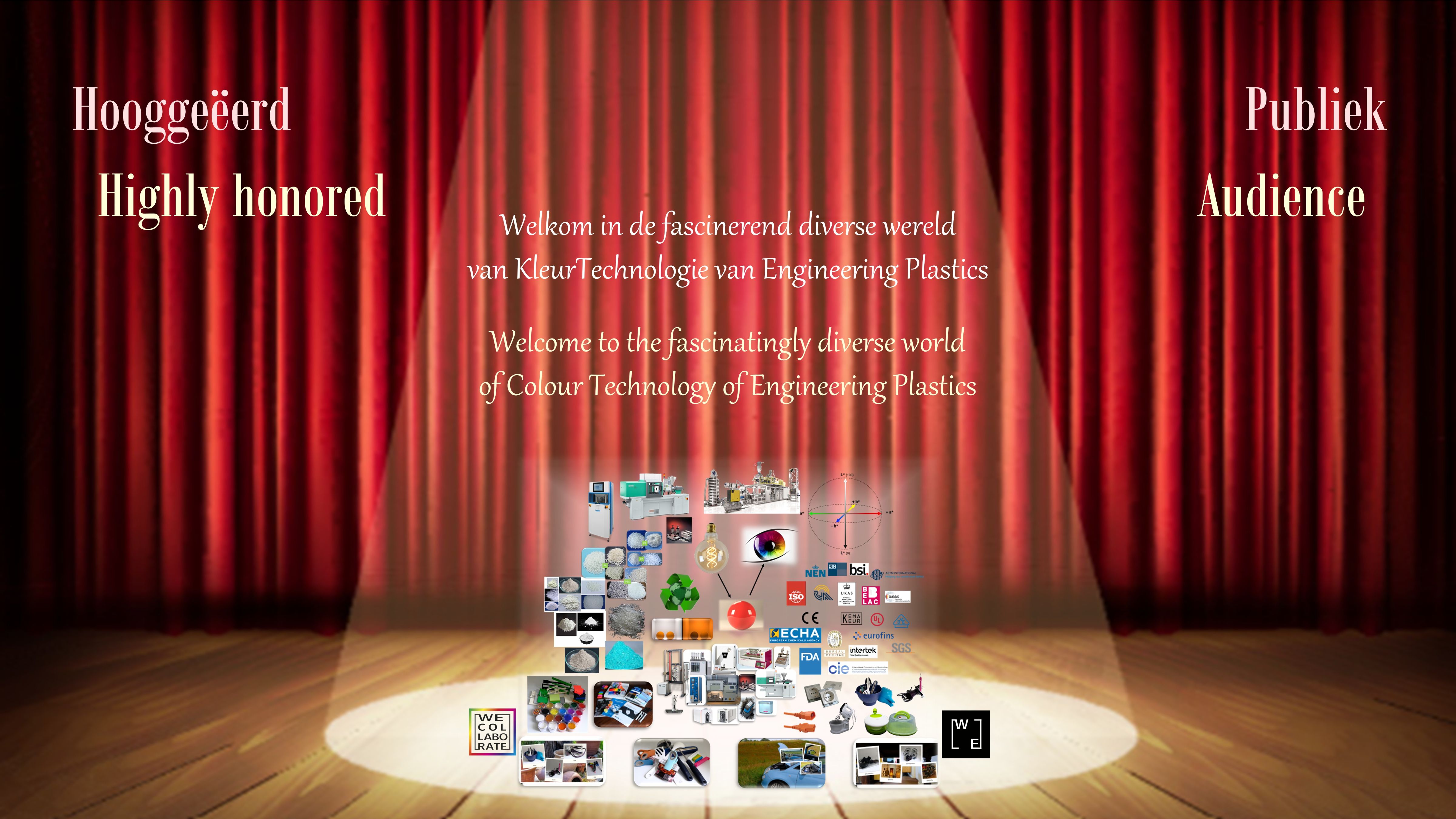
Welcome in my fascinating world of Colour Technology of Engineering Plastics!
Now, I often say that "Colour isn't rocket science," especially when operators and even product and process technologists look at colourists and colour experts with a certain degree of admiration.
And for the technology part, that is certainly true.
Because, if the plastic type, based on the required properties for an application, is known, you also know how to compound that plastic and then, for example, injection mould or 3D print it.
Then, as a colour expert, you know which pigments and dyes you can and cannot use.
And you know how and with which spectrophotometer (or visual) you should analyse the produced plastic to check whether you have met the customer's specifications.
It becomes more exciting when that colour is at the extremes of the colour wheel, extremely white or black, or yellow or blue or red or green or cyan or magenta or…
Or when that colour must remain stable for a very long time under demanding conditions.
Or when the processing temperature is extremely high…
Or when the composition of the plastic is very complex, for example, containing both fiberglass and flame retardant or impact modifier.
Or when the desired material properties and colour must be combined with special features such as LASER marking.
That is when the magic of Colour Technology begins for me, requiring all my creativity, knowledge, and experience to achieve the desired result. I sometimes need all my patience, as well as positivity and self-confidence, to keep going, even if the first 10 attempts don't work.
But to achieve this, I've spent years researching all sorts of colourants, searching at every relevant fair and in every website for both well-known and (for me) unknown pigment and dye manufacturers, speaking with every relevant expert in the field of extrusion and injection moulding of technical plastics, completing necessary additional training, discussing the final products and the necessary colour and material properties with customers, exploring the application limits of each pigment, dye, or combination, and searching for processes or additives to push those boundaries even further.
Subsquently, it's essential that the developed colour formula can be produced reproducibly and repeatably, with well-defined specifications. And in the event of deviations during production, a systematic search for the root cause...
…which is sometimes the well-known needle in the haystack.
The incident that I remember most in my career as a Colour Expert is the production of a light grey material, produced many times before, suddenly being too yellow and remaining so (!). You then need someone who knows which raw materials can cause this and why, someone who can systematically and analytically find the root cause. By the way, also someone who knows that you should not do this alone. It's called colour deviation, but often you need Process Technologists, Operators and Colourists to work together to find the source… even if it's just to brainstorm and generate new ideas to find that "needle."
Long story short: I was able to trace it back to the whitener from an alternative producer with a somewhat inhomogeneous coating that subsequently reacted with its environment.
This was only visible in the production extruder, with its more demanding process conditions (temperature, friction) compared to the lab extruder. It demonstrates also the importance of good and representative upscaling!
It's precisely that combination of creativity and analysis, chemistry and technology, individualism as a colour expert but also teamwork, in my own work environment, and joining forces with raw material suppliers, that still fascinates me so immensely even after more than 25 years!
Feel free to contact us or request a quotation