

Learn to communicate?
“Something is rotten in the state of Denmark”, or at least with our spoken Dutch language. I am a fairly loyal follower of “het NOS Journaal” (Dutch equivalent of BBC news) and it is my belief that a significant part of the words and how they are pronounced are copied by a significant part of the Dutch.
And lately I've been listening with increasing wonder to various changes in emphasis and this doesn't fall into the category of language "hammock effect." (I hope this translation works for English speaking readers)
FYI: The "hammock effect" in language refers to how audience attention fluctuates during a speech or presentation, resembling a hammock. Attention is high at the beginning and end, but tends to drop in the middle. This middle dip is the "hammock" where audience engagement can be lower. (ref. Google-AI).
What I mean and write about in this blog is this effect within one word.
In the Dutch version of this blog I mention examples of recently heard and unexpected changes in primary stress of names of villages or cities, towers, churches and bridges. Many more everyday words come to mind….….nothing seems to be sacred anymore.
.It may be me - perhaps “Van Dale” (the Dutch version of “Oxford English Dictionary”) has changed the pronunciation somewhere? - but I think it sounds strange.
Language matters! Both in what you say and how you say it… every nuance counts.
And that is no less true for colour language.
When you describe a colour, it is useful that the sender and receiver understand each other.
If you and a fellow colour specialist are standing next to each other and both of you are looking at the same object or plate, it is sufficient to use terms such as “reddish yellow” or “yellowish green” or “greenish blue”.. But if you are in different locations and the receiver has follow up actions with these descriptions, it is nearly impossible to do.
Fortunately, our (colour technical) “ancestors” thought the same. Colour order and communication dates back, as far as we know, to 1611, and was increasingly shaped by various scientists, such as William David - Wright - John Guild - David L. MacAdam, and the foundation of the CIE (Commission Internationale de l'Éclairage) in 1913.
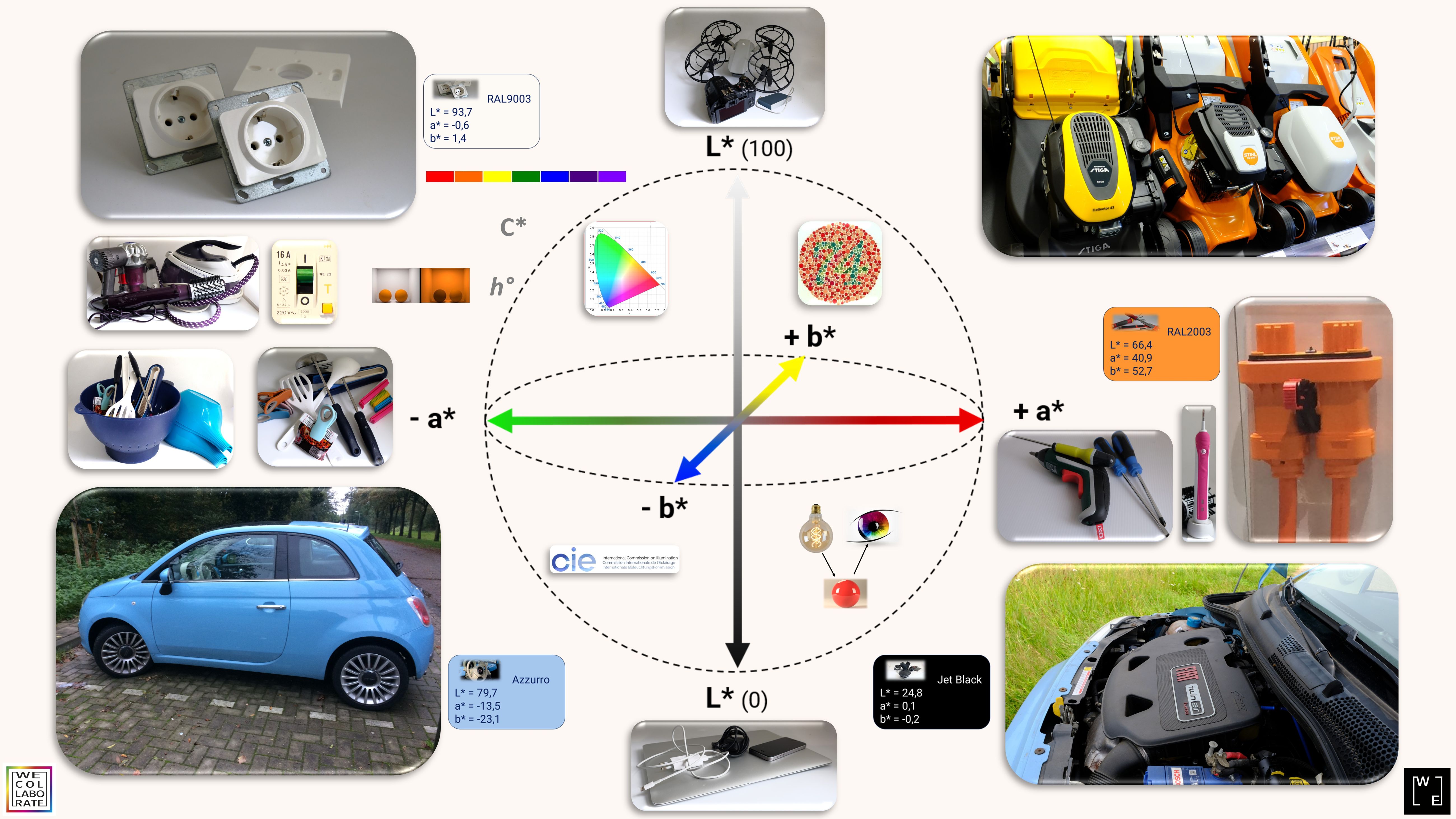
Today, L*a*b*, hue and chroma are part of the standard language of Colour specialists, a colour spectrophotometer and light cabinet are the standard tools for every colour analysis.
When we describe a colour with the relevant colour indicators, even a colourist working 20,000 km away can determine the exact standard and colour. When information on metamerism and material properties is also given, a colour development can be carried out precisely with the correct colour raw materials. Colour language has become standardised and normed!
Of course, there is more to a good colour analysis, because what geometry do you need, which deltas does the customer accept or can you produce at all, which lamps are needed, how do you interpret colour differences, what do you do with the L*a*b* versus visual colour assessment?
And yes, with a precise colour development you must really look at the colour properties of each pigment/dye that you want or have to use, determine what the influence is of colour on material properties and assess sustainability and REACH of the colour raw materials?
And last but certainly not least, how do you produce Repeatable and Reproducible coloured plastics, which quality system do you use in your company, do you have qualified (and skilled) professionals working, how do you deal with customer specifications or complaints?
But the basis is and remains that the definition of the language is standardised, so that two colour specialists can communicate equally about colour.
And the great thing is: colour communication can be learned!
Disclaimer: The English blog differs from the Dutch blog, because the examples given and the grammar are typically Dutch.
Feel free to contact us or request a quotation