

Maslow?
We humans are a unique species in the "animal kingdom," unpredictably complex yet, at the same time, easily predictable. We have the gift of creating music and art, developing highly complex scientific and technical applications, yet also destroying buildings and countries and hurting people. Humans generally differ from animals (although research increasingly shows that nuance is sometimes needed) because we possess language, morality, self-awareness, and free will.
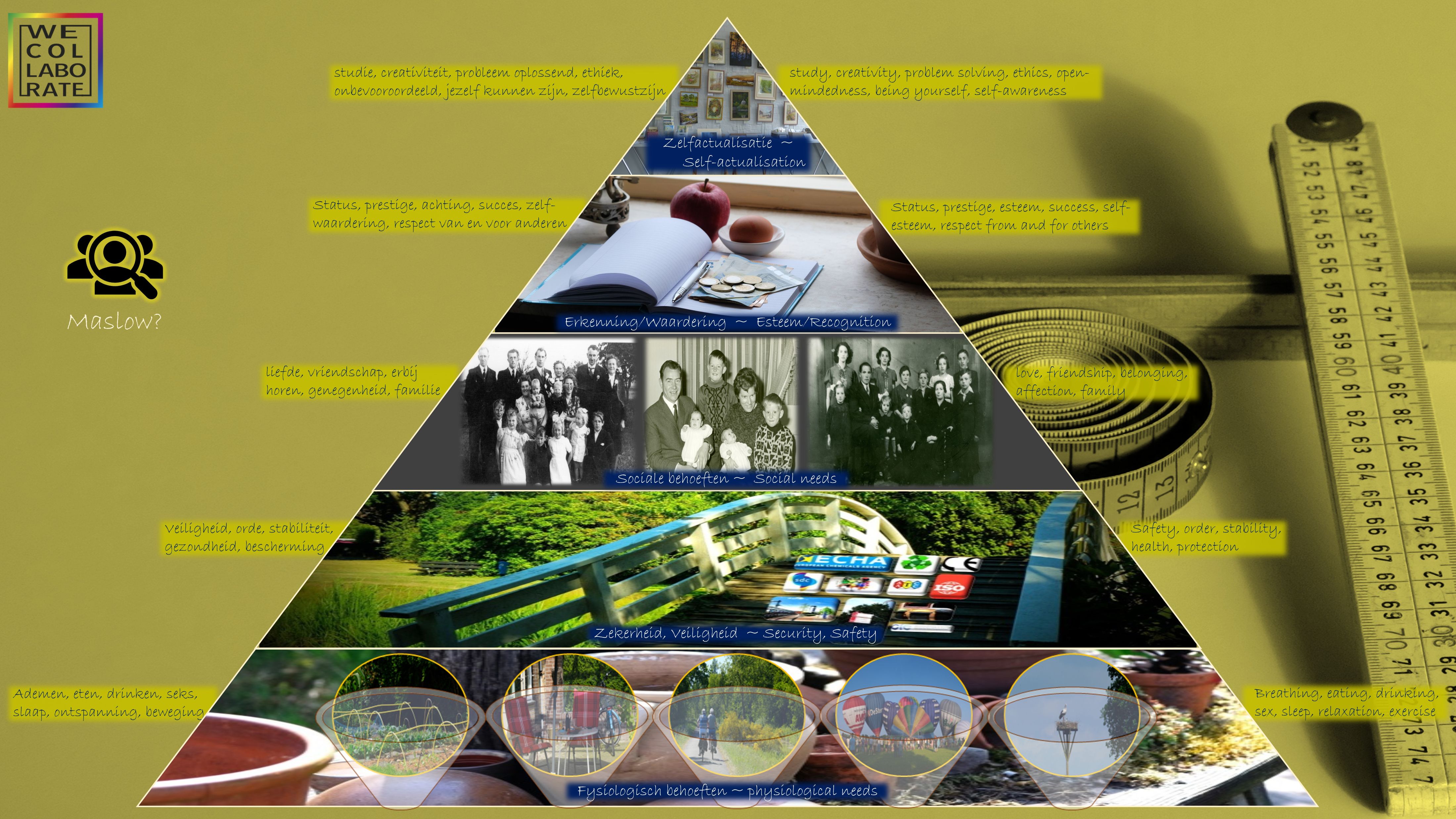
Our desire to establish order inspired Abraham Maslow (Clinical Psychologist, US, 1908-1970) to publish his well-known “Theory of Motivation” in 1943, with the Maslow Pyramid, which in short divides all our life necessities into 5 main themes and states that people are only motivated to pursue the higher level of needs once the lower (basic) one have been met.
There are some arguments to agree with Maslow.
It is merely logical to conclude that food, water, shelter, clothing, safety, and health are among the basic human needs. You can love music all you want, but if there's a shortage of water or food, or if bombs are falling daily in your neighbourhood, the lowest basic needs become your first priority. And you can live in a safe country, like Netherlands, but if the government corners you and you're in danger of losing everything you hold dear, your first priority is to regain control over your life and that of your family, and above all, to seek justice (and protection).
So, for every part of Maslow's pyramid you can think of examples of why one aspect is prioritised over another... it is fair to say that the different "steps" in the pyramid are logically chosen.
Where I struggle to agree is the definition that the lower step must first be met before the individual is motivated to fulfil the higher step. And also with the addition that it is universally applicable for every individual.
What Maslow (in my humble opinion) might have insufficiently questioned are aspects such as time, individual and cultural variations and group dynamics.
In times of need, a parent will almost always choose their child's needs and prioritise their own. When the suffering or the threat of war lasts longer, people are able to establish some kind of "new normal" and fulfil the "higher" needs in the pyramid. And often, in adverse circumstances, music and religion, or other forms of art and culture, provide the sought-after comfort to cope with everyday hardship. Consider for example the important work of War Child, using music and dance to help children process their very traumatic (war) experiences.
Learning and education, preferably ofcourse the interesting and unique training of weColLaborate, is highly beneficial to our personal development and is almost always, in one form or another, in combination with more than one of the other steps in Maslow’s pyramid.
Throughout human history, there have been several individuals with exceptional qualities who could motivate an entire nation to fulfil multiple steps in Maslow's pyramid.
Although, in our time, individualism is rampant (especially in Western culture), humans are and remain a flock of animals (we once were a pack of animals)…we do need each other. Particularly so in special situations, both negative (war, disasters) and positive (European Champion, birth, birthday), where it's so wonderful, and sometimes even essential, that the individual can share this with others. And many innovations wouldn't have happened without the collaboration of and by many.
It sometimes seems like policymakers also use Maslow's pyramid, but only partially. Safety and security are mentioned by definition in all sorts of election manifestos, but I rarely hear politicians talk about the importance of family and social cohesion... and arts and culture are the first to be "sacrificed" when budget cuts have to be implemented. Just look at the €20 million budget cuts to public broadcasting in Netherlands, which resulted in various (popular among the TV watchers) programs being cancelled.
Just watching for example the about-to-be cancelled serial program of dutch writer, winegrower and presenter, Ilja Gort, teaching me about France and the French ("just nice people," which is also my modest experience), and wine is merely the framework on which the program rests. And no, it's not a glorification of wine (apparently the opinion of some at the public network?)... although: what would be wrong with that? Should there then also not be cooking programs like "The Great British Bake Off", or only featured with low-sugar and low-salt recipes?
Whatever your preference, the vast majority of programs on public broadcasting meet, in my opinion, the public broadcaster's criteria: "information, culture, education and entertainment, and serving the general interest of society." (Dutch criteria, but probably also valid for the BBC).
One point of criticism though on the Dutch broadcasting: Just because I am so passionate about good journalism, I think the number of programs presenting the day's news could be reduced a bit: what's the difference between all of the various news programs? And then the same items being discussed at the various late night shows (with guests)? You do get the feeling they've cut back on editorial staff though, because the questionnaire is the same everywhere, the only difference being the way it's asked (which depends on the political "colour"). I miss the depth and real journalistic input, too much superficial approach to complex topics, too many topics (or guests), too few experts, and the presentation is largely in the hands of talk show hosts (which isn't necessarily a bad thing, but I would then prefer it with more humour, like John Oliver, Jon Stewart or, in Netherlands, Arjan Lubach).
Can't those 20 million euros budget cut, in Netherlands, be cut? We'll have to let our budget deficit grow in the coming years anyway, because there's no way you can cut enough to finance the necessary increase in the defence budget. So, Dutch Cabinet: “allez”, be sensible and borrow with Europe for defence!
Of course, there are immediate necessities of life and other needs that can wait, in that sense Maslow is right, but whether it should be divided into closing one phase and only then starting a successive phase is questionable... humans are able, in my opinion, to a greater or lesser extent, to combine the different steps of the pyramid.
Disclaimer: in this English version blog some very Dutch examples of public broadcasting are not mentioned.
Feel free to contact us or request a quotation