


Metamerism?
In the world of colour there is one subject that is perhaps the most underestimated and certainly not always understood how to deal with…Metamerism.
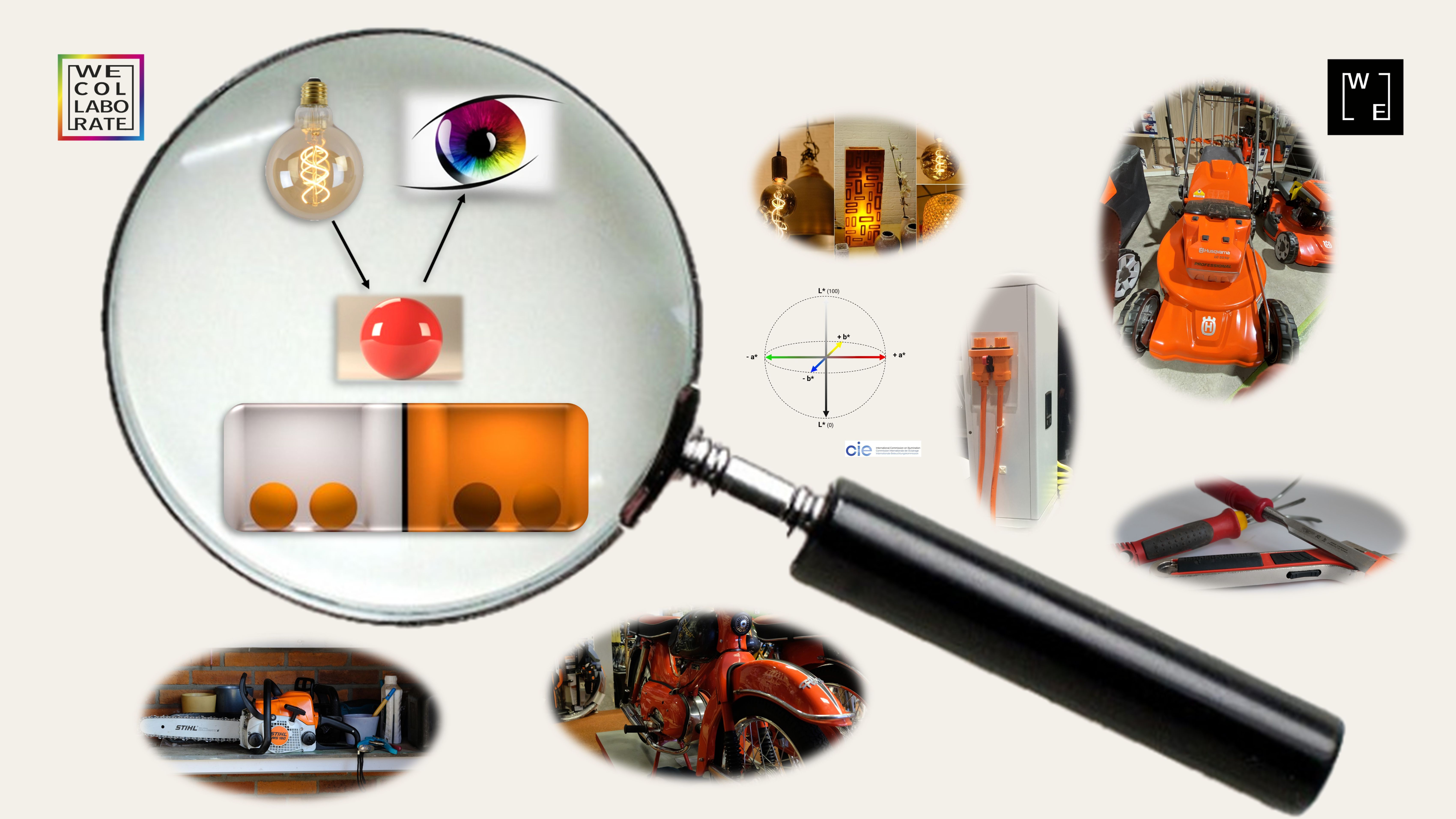
Its formal definition is “the colour difference between reference and samples under different lights” (training weColLaborate E-learning module Colour Theory and Practice).
But what does this mean in practice?
The global standard for measuring and visually assessing colour and colour difference is performed with D65, Daylight of 6500K. Almost all colour labs use this to colour match a customer reference in the wide range of different plastics with the pigments and dyes that can be used in these materials.
You would think that once you have achieved the correct L*a*b* values, you are done. Well, not quite!
For black, white, beige and all greys this is certainly true, because for these “colours” often only inorganic pigments are used that hardly show any Metamerism among themselves. But when it comes to all high chromatic colours, with the use of a variety of organic pigments and dyes, such as Husqvarna and Stihl Orange or Stiga and DeWalt Yellow or Bosch and Makita Blue (in short: the Powertool segment), Metamerism is a factor to take into account.
When you go to a hardware shop to buy a new mower or chainsaw, these are often expensive devices and you want good quality. Now, most people have already made a choice in advance based on the brand and the price, but you still want to see and “feel” it. And colour differences make or break the “feeling” of quality and is indirectly a justification for the not insignificant price. Most hardware shops usually have fluorescent lighting, but no customer goes so far as to take the device outside to perform a proper colour evaluation. And therein lies the problem.
Many power tool manufacturers have different plastic suppliers, often because of security of supply and (competitive) prices. And subsequently all kinds of small and large differences in colour recipes are introduced.
Almost all devices are an assembly of different parts and the plastic parts of them can be of different types, usually because of specific properties that are needed. Often these differences are only in the fillers or glass fibre percentages, but sometimes they are also different polymers.
Most power tool manufacturers have well defined specifications, including Metamerism, and send a secondary standard for which the new plastics supplier must then develop the colour recipe. And almost all companies define with which lamps the Metamerism must be analysed, such as the TL lamp (known as TL84 or CIE Illuminant F11), the incandescent lamp (Tungsten lamp or CIE Standard Illuminant A), or the, especially popular in America, fluorescent phosphor lamp (known as CWF or CIE Illuminant F2). Because all professional colour spectrophotometers can calculate the Metamerism for all CIE standard lamps and the colour cabinets, for visual assessment, have at least a D65 and TL84 lamp, the analysis is often not the problem, but the secondary standard is! Because what material is it made of and is its colour recipe, often developed in such a way that the plaque or plate is colour stable for at least 5 years, representative for the application and the plastic type?
The ultimate goal is that when a random customer enters the hardware shop and sees that beautiful mower from that one supplier, he sees in one look that all the parts are sufficiently similar per colour in the shop and… then buys the device. And so, a mower must look “nice” in the shop and, in that short period before it is used, in daylight. It is a form of display or window dressing, the most important thing about a mower remains that it does what it is supposed to do and lasts at least 10 years, but still: looks are important too, especially when buying!
It is not enough to just define a RAL2003, it is not enough to just provide your extremely stable secondary standard, you have to consider in which part the plastic is going to be used, which plastic (or competitor material) the adjacent part (or complete device) is, which pigments and dyes have to be used and if, for example in the context of sustainability and new applications, significant changes in plastics and colourants are to be expected.
And so it is important that manufacturers of, among other things, both power tools and the plastics shine a light on Metamerism, not only in the definition and specification, but also in applying it.
Its formal definition is “the colour difference between reference and samples under different lights” (training weColLaborate E-learning module Colour Theory and Practice).
But what does this mean in practice?
The global standard for measuring and visually assessing colour and colour difference is performed with D65, Daylight of 6500K. Almost all colour labs use this to colour match a customer reference in the wide range of different plastics with the pigments and dyes that can be used in these materials.
You would think that once you have achieved the correct L*a*b* values, you are done. Well, not quite!
For black, white, beige and all greys this is certainly true, because for these “colours” often only inorganic pigments are used that hardly show any Metamerism among themselves. But when it comes to all high chromatic colours, with the use of a variety of organic pigments and dyes, such as Husqvarna and Stihl Orange or Stiga and DeWalt Yellow or Bosch and Makita Blue (in short: the Powertool segment), Metamerism is a factor to take into account.
When you go to a hardware shop to buy a new mower or chainsaw, these are often expensive devices and you want good quality. Now, most people have already made a choice in advance based on the brand and the price, but you still want to see and “feel” it. And colour differences make or break the “feeling” of quality and is indirectly a justification for the not insignificant price. Most hardware shops usually have fluorescent lighting, but no customer goes so far as to take the device outside to perform a proper colour evaluation. And therein lies the problem.
Many power tool manufacturers have different plastic suppliers, often because of security of supply and (competitive) prices. And subsequently all kinds of small and large differences in colour recipes are introduced.
Almost all devices are an assembly of different parts and the plastic parts of them can be of different types, usually because of specific properties that are needed. Often these differences are only in the fillers or glass fibre percentages, but sometimes they are also different polymers.
Most power tool manufacturers have well defined specifications, including Metamerism, and send a secondary standard for which the new plastics supplier must then develop the colour recipe. And almost all companies define with which lamps the Metamerism must be analysed, such as the TL lamp (known as TL84 or CIE Illuminant F11), the incandescent lamp (Tungsten lamp or CIE Standard Illuminant A), or the, especially popular in America, fluorescent phosphor lamp (known as CWF or CIE Illuminant F2). Because all professional colour spectrophotometers can calculate the Metamerism for all CIE standard lamps and the colour cabinets, for visual assessment, have at least a D65 and TL84 lamp, the analysis is often not the problem, but the secondary standard is! Because what material is it made of and is its colour recipe, often developed in such a way that the plaque or plate is colour stable for at least 5 years, representative for the application and the plastic type?
The ultimate goal is that when a random customer enters the hardware shop and sees that beautiful mower from that one supplier, he sees in one look that all the parts are sufficiently similar per colour in the shop and… then buys the device. And so, a mower must look “nice” in the shop and, in that short period before it is used, in daylight. It is a form of display or window dressing, the most important thing about a mower remains that it does what it is supposed to do and lasts at least 10 years, but still: looks are important too, especially when buying!
It is not enough to just define a RAL2003, it is not enough to just provide your extremely stable secondary standard, you have to consider in which part the plastic is going to be used, which plastic (or competitor material) the adjacent part (or complete device) is, which pigments and dyes have to be used and if, for example in the context of sustainability and new applications, significant changes in plastics and colourants are to be expected.
And so it is important that manufacturers of, among other things, both power tools and the plastics shine a light on Metamerism, not only in the definition and specification, but also in applying it.
Feel free to contact us or request a quotation