


Thank you for your feedback...
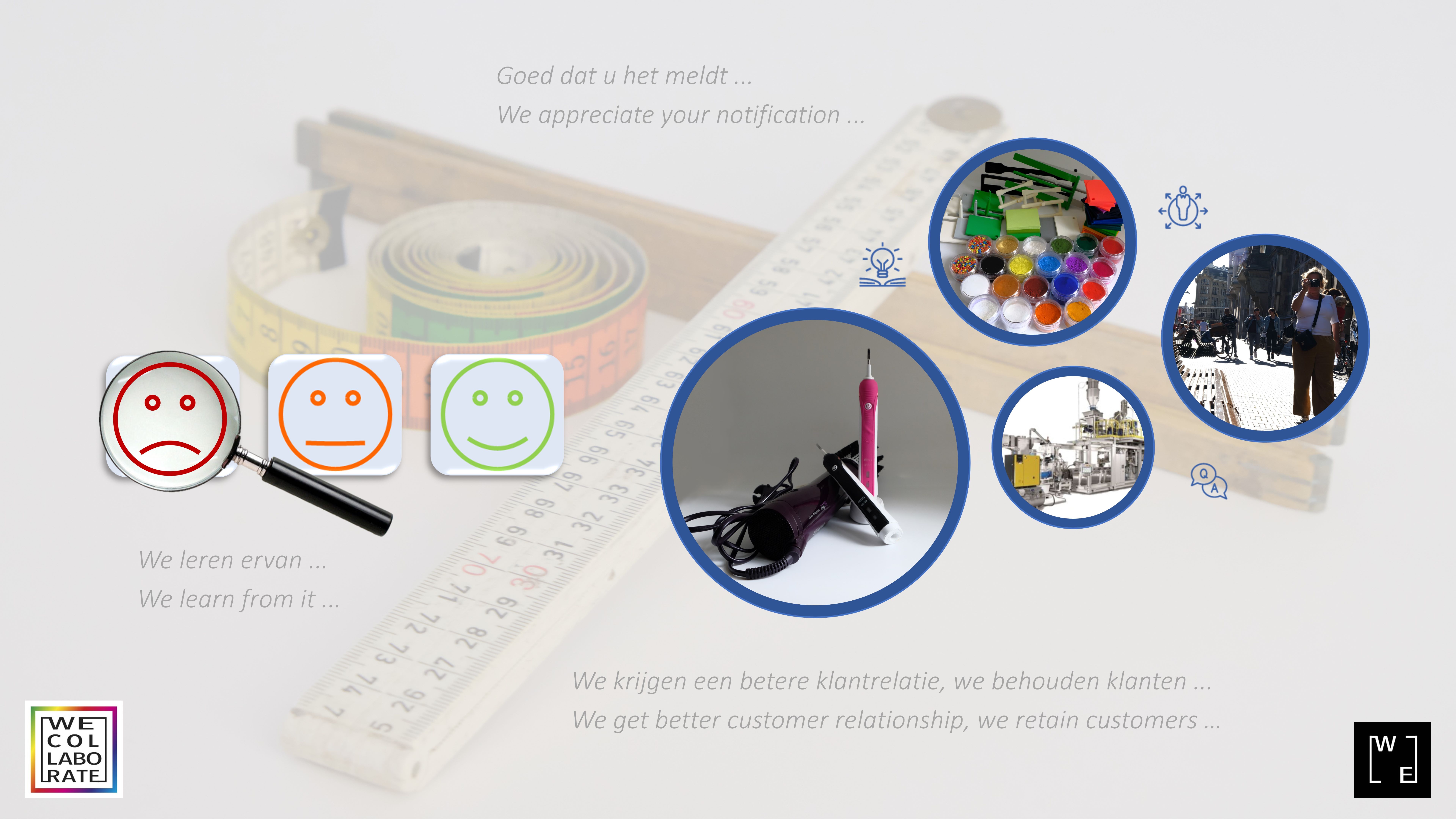
I hardly ever do it, but a few weeks ago I e-mailed some content-related comments to a Dutch public service broadcaster about “het Journaal” (daily news).... And I promptly received an, I think, automatically generated response (google translate): “We are happy with the many responses we receive from our viewers, listeners and readers. Whether it concerns a compliment, point for improvement, or suggestion; We ensure that this ends up with the right editors.”
Also, because I have not received any further response until today and nothing has changed at “het Journaal”, this made me think.... because how do you act towards complaints?
Every company or agency has a complaints service with a procedure or step-by-step plan; you are all familiar with it: Listen and show understanding. - Make an apology. - Look for a solution. - Make sure you follow up with the customer. - Exceed expectations.
And all of them, including myself in the past, promote the importance of complaints: “it is important and good that a customer reports a complaint”, “we learn from it” and “it is an opportunity to improve the customer relationship”...
But, in practice!?
Usually the complainer receives a standard response and, sometimes cringeworthy, there is understanding for the complaint...
Usually an organisation goes into some sort of panic mode, because no one likes a complaint and it is taken too personally...
Usually people think in terms of responsibility and liability...
And usually the number of complaints, and actually minimising it, is a measure of the quality of a company...
If you ever have had a problem with one or more of your TV channels, you know the first question from the helpdesk is whether you have connected the cable correctly... I find it hard to believe that this is the number 1 cause of TV channel malfunctions. I once had to call 5 times and the only remaining option was to reset my entire account (with the loss of all emails and other settings) and on the 6th time an employee suddenly asked me if a TV software update might be needed (because the provider had changed something with certain channels in the weeks before!) and yes, the problem was solved within 5 minutes (!).
If you ever have had a problem with your electric doorbell costing 30 euros or toothbrush costing 60 euros, in Netherlands, you know it now has to be sent to the producer and you will be without it for at least 3 weeks. And you suspect that they are not going to repair it, but will send a new one, and then communicate a “cause” (you have to ask!) about which you have, as a fairly technical person, reasonable doubt whether this is even possible.
Large companies, with large customers, are increasingly unable to get away with this. A thorough investigation must take place, there must be good communication, the cause must be clear and not a generic solution to prevent recurrence: the “we are going to re-instruct the employees” has not been an accepted plan for some time.
Customer complaints have been presented for a long time via the well-known Iceberg construction: the customer complaint is the tip that sticks out above the water surface and the largest part, the sum of cause - near accident - incident - internal notification, is not visible. And in this invisible part lies the opportunity to prevent customer complaints.
But then correlations must be found: has there been an increase in analysis deviations, have there been internal notifications, were there near-accident reports, was there an incident that preceded it... and preferably of course one recurring source, either from a device or an operator or a work instruction or intrinsically related to a raw material or end product.
In all the years that I have worked at DSM (now Envalior), these have rarely been found or at least far too few!
And why is that?
Do employees not dare to report near misses and incidents? Is there no perceived safe culture within a company? Do the managers justify any deviations in a contradictory manner? Are there too few people or insufficient preventive maintenance due to all kinds of cutbacks? Managers are even fired if the KPI on safety, for example, is not achieved - Is this perhaps a negative incentive? Do the employees not have enough quality to recognise near incidents? Is there nonchalance within a company “things went well, so why should I report it”?
Or...is there no correlation? Will unexpected things always happen, because people are people and are not perfect?
Look at aviation: nowhere is there such a high, at least 8-sigma, safety standard and yet accidents still happen and there is almost always a human factor underlying this (inadequate design or material, wrong decision by pilot or maintenance man/woman, saving on materials and maintenance, etc.). Even if everything were “perfect”, there could be something like an unexpected weather event that would cause something that no one (?) had anticipated in advance.
Can the rest of the world learn something fundamentally from the airplane builders? However painful, the extremely high level of quality awareness and standards has only been achieved by independently (!) and meticulously investigating each incident by experts to determine the cause, and by defining an extensive set of measures that are considered from all sides to prevent recurrence, subsequently communicating this extensively and have it rigorously implemented throughout all ranks.
And let's face it: the prestige of the investigative agency is determined by the quality of the investigation and the continuation of the airplane manufacturer is at stake if the recommendations are not or insufficiently followed (look at Boeing).
Companies and authorities, Practice what you Preach: accept that solely without customers there are no complaints - do not make any (pre-) assumptions, investigate independently and thoroughly, find not only the source, but also any contributing factors or side effects - define adequate measures and implement them fully, and... actively test whether the measures have the defined effect - communicate correctly, completely, timely and regularly during and after the research, be open about your findings.
Now, in my opinion, there should also be something in between Internal Notifications and External Complaints, but that is material for a next blog on this subject.
Receiving a complaint is not fun, but neither is sending a complaint! So, the more open, realistic, involved and professional you deal with complaints, the better your own organisation or product will be and ultimately your customer relationship.
Feel free to contact us or request a quotation